
To analyze a chess game with PGN, first reconstruct the game without an engine, mark the moments where your plan changed, and only then compare candidate moves with engine guidance. PGN gives you a reproducible record; it does not explain why a move was difficult.
Key takeaways
- Review the position before checking engine scores.
- Mark decisions, not every move equally.
- Turn each mistake into one practical question.
Import and verify the record
Open the PGN in a trusted analysis board and confirm the players, result, and move count. If the position looks illegal or the game stops early, fix the source file before drawing conclusions. A missing half-move can change the entire explanation.
Replay the opening once at normal speed. Note where you left familiar preparation. This is a boundary for study, not automatically a mistake.
Make a human pass first
On the second pass, pause before checks, captures, threats, exchanges, and moments when your time dropped. Write what you were trying to do and list one alternative you considered. Then ask: what changed after my move?
Use a simple label such as opening, calculation, tactic, strategy, time, or endgame. Labels help you find repeated decisions across several PGNs without pretending that one centipawn number explains your play.
Compare candidate moves
Now turn on engine analysis. Look at the top few candidate moves, but inspect the resulting position rather than memorizing the first line. A small evaluation change can be harmless in a practical position; a quiet move can be difficult even when the score barely moves.
For each critical moment, write a human sentence: “I moved the knight because I feared the pin, but the direct exchange removed the defender.” This connects the engine's suggestion to your original thought.
Illustrated worksheet
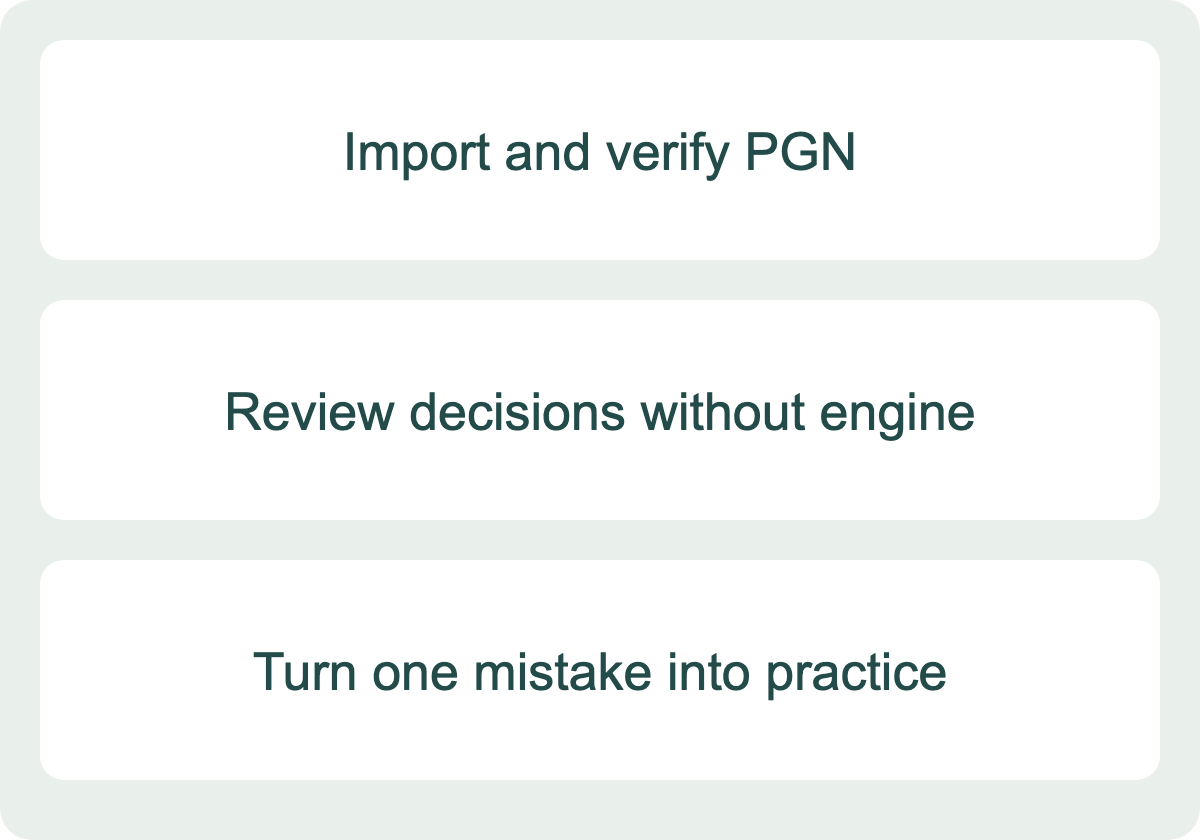
This diagram summarizes the example in this article.
Check the position after the tactic
When the engine flags a blunder, rewind one move and search for the earliest point where the danger became visible. Identify the attacked piece, loose defender, forcing reply, or changed pawn structure. The earlier question is usually more useful than memorizing the final tactic.
ChessStep's game review method provides a repeatable review loop. You can also practice the decision against the computer, then compare your explanation with the PGN.
Turn analysis into practice
End with one action: solve three positions from the game, replay the critical opening without hints, or practice the relevant endgame. Store the PGN with your notes and date so you can revisit the same decision later.
A PGN is valuable because it preserves the sequence. Your analysis becomes valuable when it turns that sequence into a question you can answer in the next game.