

The French Defense chess opening begins 1.e4 e6. Black prepares to challenge White's center with ...d5, commonly producing 1.e4 e6 2.d4 d5. For a beginner, the useful first lesson is the purpose of those pawn moves, followed by how White's reply changes the position.
Chess.com's French Defense overview identifies that central challenge and the main variations. This short guide turns those ideas into a focused practice session, without asking you to memorize a long repertoire.
Key takeaways
- Black's ...e6 supports the planned ...d5 challenge.
- White can advance, exchange, or defend the e4-pawn.
- Choose moves from the current position, not a remembered sequence alone.
Understand what ...e6 changes
After White plays e4, Black's e-pawn moves from e7 to e6. That pawn now protects d5, making the planned central advance easier to explain. It also opens a diagonal for the bishop on f8.
There is a trade-off: the bishop on c8 has less freedom because the e6-pawn blocks its diagonal. Notice both effects. A “solid” opening still requires development and attention to threats.
Set up 1.e4 e6 2.d4 d5 on a board. Find Black's pawn attacking e4, then find the pawn supporting d5. Naming the attacking and defending pieces makes the sequence more useful than repeating the notation.
See the difference between advancing and exchanging
After 3.e5, White advances the e-pawn and closes the immediate central contact. This is the Advance Variation. White's pawns on d4 and e5 form a chain: the d4-pawn protects e5.
After 3.exd5, White instead captures Black's d5-pawn. Black can answer 3...exd5, producing the familiar Exchange Variation structure. The central pawn arrangement is now different, so the plan you were considering against e5 cannot simply be copied.
White can also defend e4 with a knight, as in 3.Nc3 or 3.Nd2. Recognize the choice first, then study one branch deliberately.
Give the ...c5 break a concrete target
In the Advance structure, Black often challenges White's d4-pawn with ...c5. That is the base of the pawn chain supporting e5. The point is to question White's center, not merely to push another pawn because an opening guide mentioned it.
Use 1.e4 e6 2.d4 d5 3.e5 c5 as a study position. Locate d4 and identify its defenders. Before any later capture, calculate the recapture and check what lines would open.
This is a plan, not an instruction to play ...c5 in every French position. A direct threat, an undefended piece, or a changed center may require something else first.
Illustrated worksheet
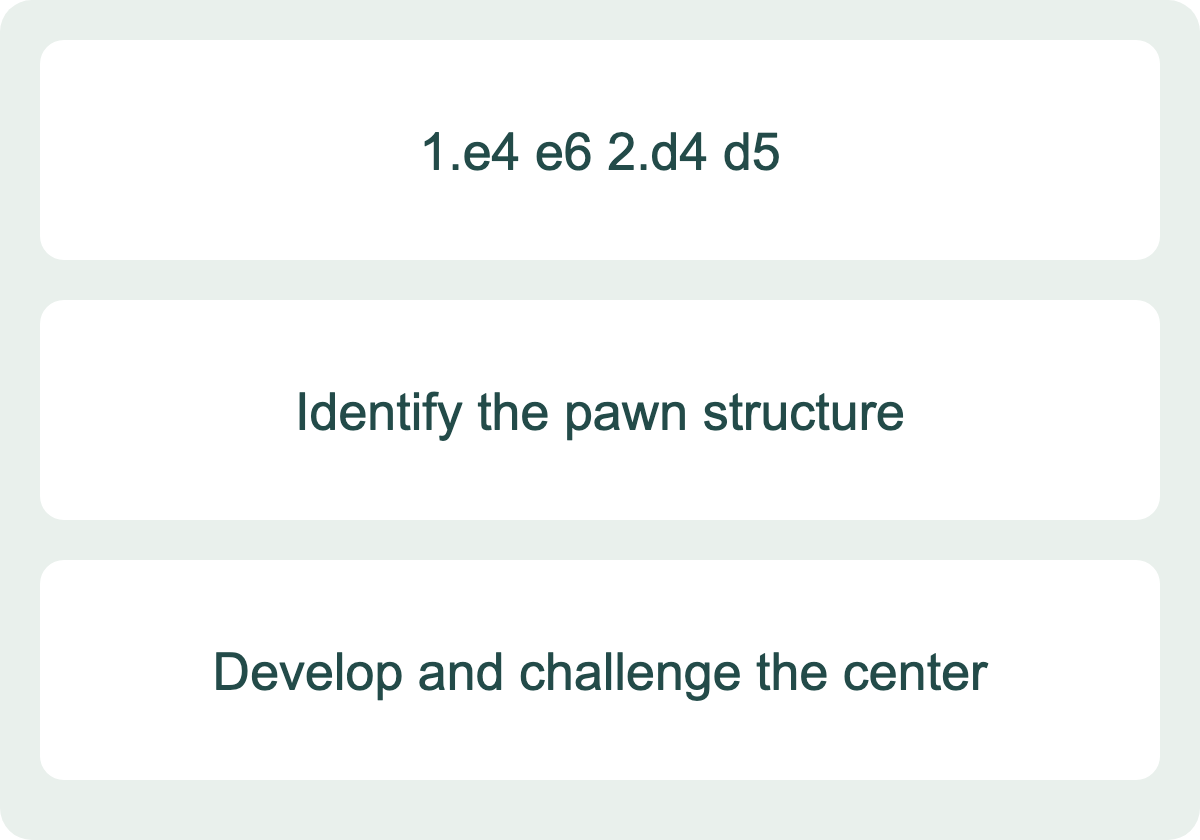
This diagram summarizes the example in this article.
Practice one branch from both sides
On a physical board, replay the Advance sequence, then explain what each pawn move accomplished. Reset and replay the Exchange sequence. Compare which central squares are occupied and which diagonals have opened.
For a full game, the computer-practice guide explains a beginner-friendly session. If your opponent chooses a different opening, respond to that position rather than forcing an illegal or inappropriate move sequence.
Keep normal move checks: threats, loose pieces, legal captures, and king safety. Opening study does not replace them.
Keep one question from the game
Afterward, identify your first unexplained move. “What was attacking d4?” is a better review question than “Why am I bad at the French?”
Use the game-review method to compare your idea with the resulting position. For your next session, repeat that decision and explain the correction. Build your understanding one pawn structure at a time.