

You have developed your knight and bishop. Castling is next on the plan. Then Black pushes a pawn to d5. If you castle without looking at what that pawn attacks, your bishop on c4 can disappear on the next move.
In the position below, 5. exd5 is a straightforward response: White’s e-pawn captures the attacking pawn. After Black’s possible reply 5...Nxd5, White can castle. This is one teaching line, not a rule to capture every pawn that reaches d5.
If you have not learned the starting moves yet, begin with the beginner opening comparison. Here, the question is narrower: how do you change your plan when Black challenges the center?
The Italian Game position to examine
Play through these moves:
1. e4 e5 2. Nf3 Nc6 3. Bc4 Nf6 4. d3 d5 *
White’s bishop sits on c4 and pawn on e4. Black’s last move, ...d5, attacks both. Black pawns capture toward White’s side of the board: from d5, the two capture squares are c4 and e4.
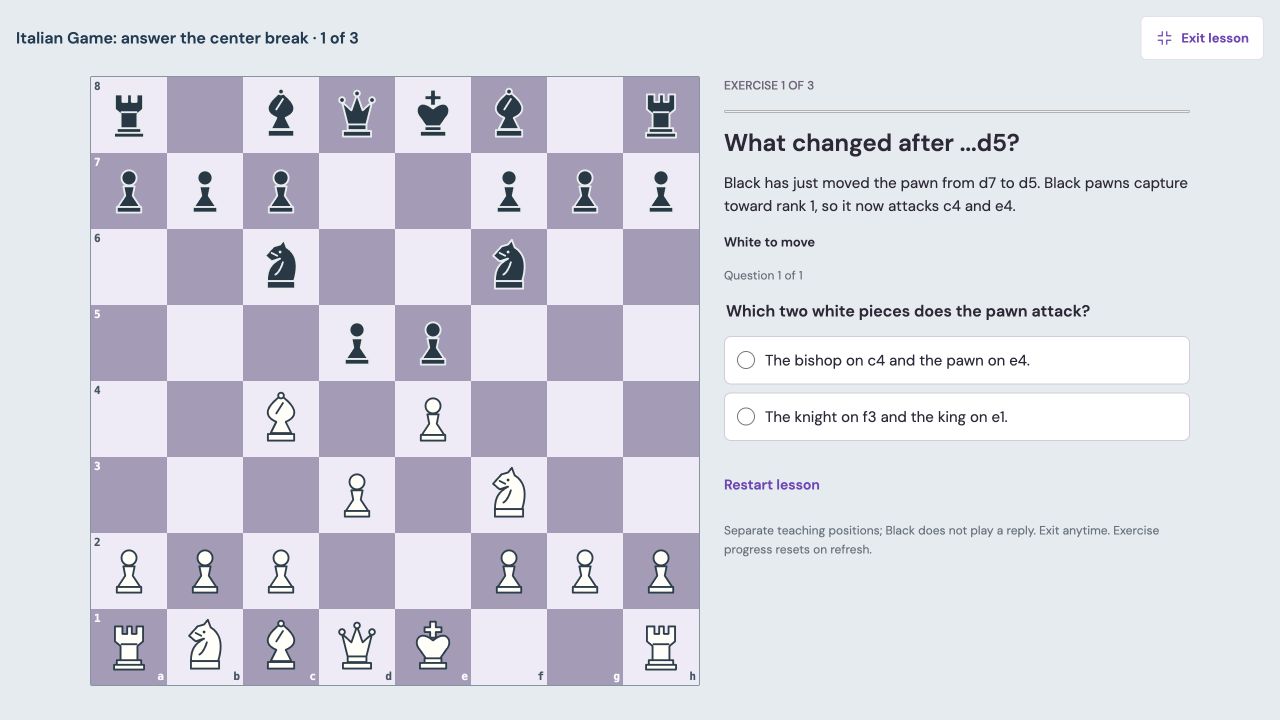
Notice that ...Nf6 came before ...d5. The knight on f6 can recapture on d5 if White exchanges pawns. Black’s moves support a plan; they are not just obstacles between the moves you memorized.
The Italian Game overview gives the opening’s starting position, 1. e4 e5 2. Nf3 Nc6 3. Bc4. The example here follows the ...Nf6 branch. Other replies lead to different positions, so the advice below applies to the displayed board.
Why exd5 answers the immediate problem
Move the white pawn from e4 to d5. It captures the pawn that was attacking your bishop. In algebraic notation, exd5 means the pawn from the e-file captures on d5.
In the moves below, N stands for knight, x means a capture, and O-O means kingside castling. The dots before a move mark Black’s turn.
Black can respond ...Nxd5, moving the knight from f6 to d5 and capturing that pawn. This is a possible continuation, not a forced reply. Each side has now exchanged one pawn. Your bishop remains on c4, and the black knight has moved into the center.
1. e4 e5 2. Nf3 Nc6 3. Bc4 Nf6 4. d3 d5 5. exd5 Nxd5 6. O-O *
After this particular recapture, kingside castling is legal: the bishop and knight have left f1 and g1, neither king nor rook has moved, and the king’s starting, crossing, and destination squares are not attacked. The FIDE castling rules, article 3.8.2, explain those restrictions.
The useful habit is to inspect the new position again after ...Nxd5. Do not assume that resolving one threat makes the next planned move safe in every variation.
What happens if you castle first?
Return to the position after 4...d5. If White plays 5. O-O?, Black can answer 5...dxc4, taking the bishop with the d-pawn. White can recapture with 6. dxc4, but that recapture does not bring the bishop back. In this exchange, White has given up a bishop for a pawn.
1. e4 e5 2. Nf3 Nc6 3. Bc4 Nf6 4. d3 d5 5. O-O dxc4 6. dxc4 *
Castling itself was legal. The problem was ignoring an attacked piece. “Develop, control the center, castle” is useful opening advice, but it does not replace checking captures on the current board.
A three-question check before you move
- What does the new pawn move attack? Here, ...d5 attacks c4 and e4, where your bishop and pawn stand.
- Does my intended move answer the threat? Castling leaves the bishop attacked; exd5 removes the attacking pawn.
- What can the opponent do next? After exd5, check the knight recapture ...Nxd5, then inspect the board before castling.
Use the same questions in other openings. The answers depend on the actual position; this example does not make exd5 the right move every time.
Practice the decision before playing another game
Open the Italian Game center-break lesson. First identify the two targets of ...d5. Then play exd5 and examine the knight recapture before castling. The board exercises use the same position shown here.
Afterward, play an untimed computer game. Your opponent may choose a different line. When it moves a central pawn, pause and name the squares that pawn now attacks. That is the transferable part of the lesson; seeing this exact sequence again is not required.
If you lose a piece, review the game and return to the position before the capture. Ask what the opponent’s previous move changed. An engine’s suggested move is easier to understand once you have identified the threat it answers.