
Suppose you learn five opening moves tonight. Tomorrow you play e4, ready to follow the plan. Black replies c5 instead of e5. You are one move into the game, and the line you memorized no longer fits.
If you keep following that line without checking Black’s moves, you can miss a threat or attack a pawn that is already defended. Before choosing another opening to memorize, learn to answer one question: what changed when Black moved?
The Italian Game, Scotch Game, and Queen’s Gambit are useful chess openings for beginners playing White. Below is a short comparison, followed by an Italian Game example where an attack gets a defensive reply. You can then try those moves on a guided board.
Which chess openings for beginners should you learn first?
These are three options, not a ranking based on win rates. The best starting point is one whose moves you can explain.
| Opening | Starting moves | What to learn from it |
|---|---|---|
| Italian Game | 1. e4 e5 2. Nf3 Nc6 3. Bc4 | Develop pieces, notice attacks and defenses, and prepare to castle. |
| Scotch Game | 1. e4 e5 2. Nf3 Nc6 3. d4 | Challenge the center directly and follow what happens after pawn exchanges. |
| Queen’s Gambit | 1. d4 d5 2. c4 | Use a side pawn to challenge Black’s central pawn and examine the resulting pawn structure. |
These are chess openings for White, and the listed lines depend on Black’s replies. Playing e4 does not guarantee an Italian Game. If Black plays c5 instead of e5, the position has already taken a different path.
For your first lesson, use the Italian Game. It lets you see a pawn move open a bishop’s path, a knight attack a pawn, and another knight defend it.
Italian Game for beginners: understand the first three moves
Chessboard squares have addresses: a letter for the file and a number for the rank. White starts at the end with ranks 1 and 2. In move notation, N means knight and B means bishop. Each numbered pair below contains White’s move followed by Black’s reply.
1. e4 e5: both sides claim space
White moves the pawn from e2 to e4. A pawn may move two squares from its starting position if both squares are empty. On e4, it attacks d5 and f5. Vacating e2 also opens diagonals for White’s bishop and queen.
Black’s pawn move from e7 to e5 does something similar. It occupies a central square, controls d4 and f4, and opens paths for Black’s pieces. Black is building a position too.
2. Nf3 Nc6: an attack gets a reply
White’s knight jumps from g1 to f3. Knights move in an L shape and can jump over other pieces. From f3, this knight attacks the pawn on e5.
Black develops the knight from b8 to c6, protecting that pawn. If White now captures e5 with the knight, Black’s knight can capture it in return. An attacked pawn is not necessarily a free pawn.
3. Bc4 Bc5: bring the bishops into play
White moves the bishop from f1 to c4, along the now-clear diagonal through e2 and d3. It points toward Black’s pawn on f7. Developing a piece means bringing it out where it can take part in the game.
Black can answer by moving the bishop from f8 to c5, pointing toward White’s f2 pawn. The white king protects f2, so this pressure is not an immediate win for Black.
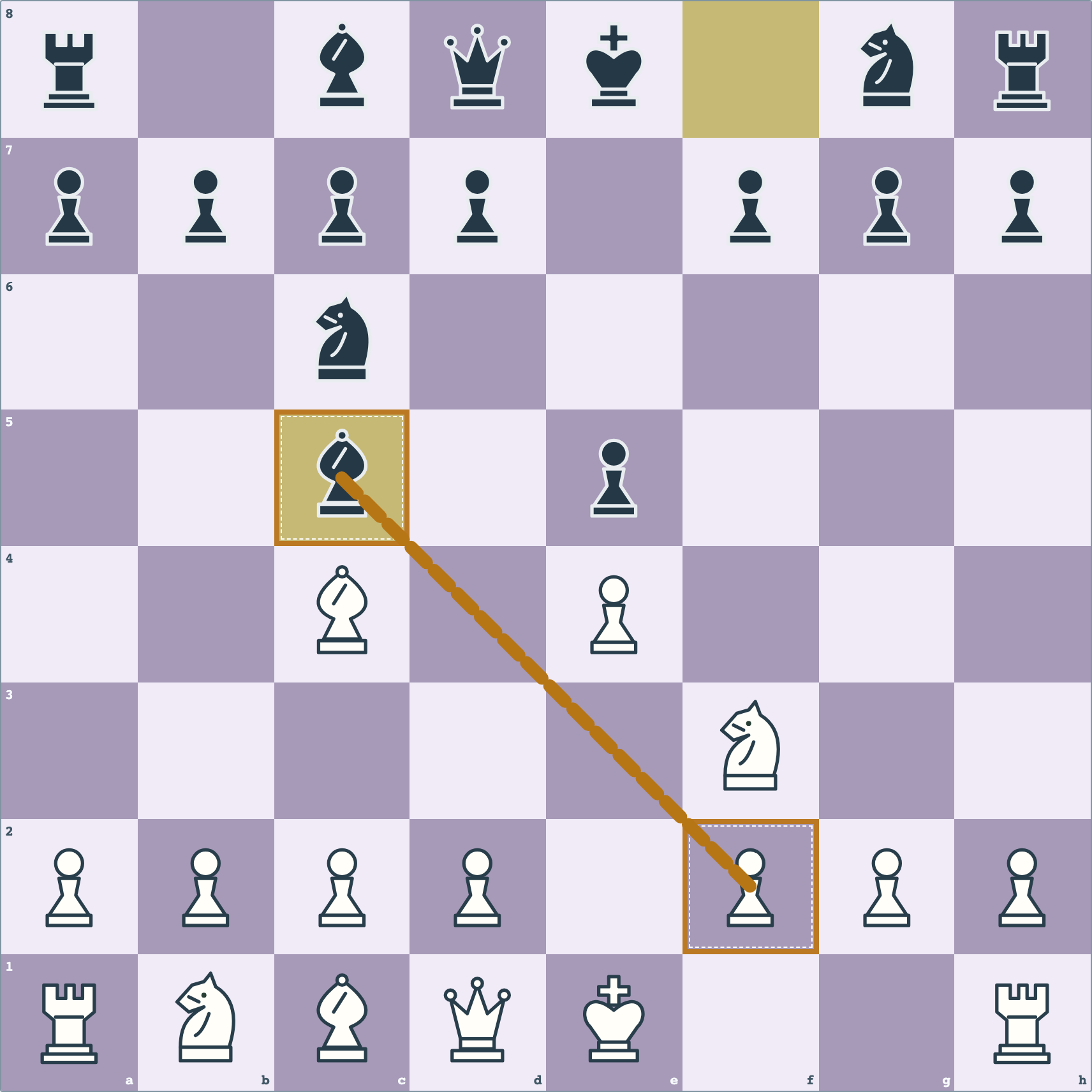
Position after 1. e4 e5 2. Nf3 Nc6 3. Bc4 Bc5, captured from the ChessStep lesson.
Practice the opening moves on a board
Open the guided first-opening lesson. It explains each piece’s movement, shows the route, and lets you watch a demonstration before trying the move yourself.
After you move, Black responds. Read what that reply attacks or protects. Select Why did Black play that? to open the explanation of Black’s last move whenever you need it. The teaching line then adds d3 and kingside castling, written O-O.
Black follows a preset line in this lesson. Completing it shows that you can follow that line; it does not mean you have mastered the opening. Try the version without move instructions afterward and explain each move in your own words.
Try the next lesson on Black’s different replies, then check captures before taking a pawn.
What if Black does something different?
Before playing the next move you remember, check whether your king is in check and whether anything is under attack. A developing move can wait if you need to answer an immediate threat.
Try a game against the computer and watch for the first unfamiliar reply. After the game, review that position. Ask what changed and which move you considered. That question is more useful than deciding the opening “failed” because the opponent left your lesson.
For help choosing a bot and a useful difficulty, see the computer chess practice guide.
For the formal rules on piece movement and castling, see the FIDE Laws of Chess.