
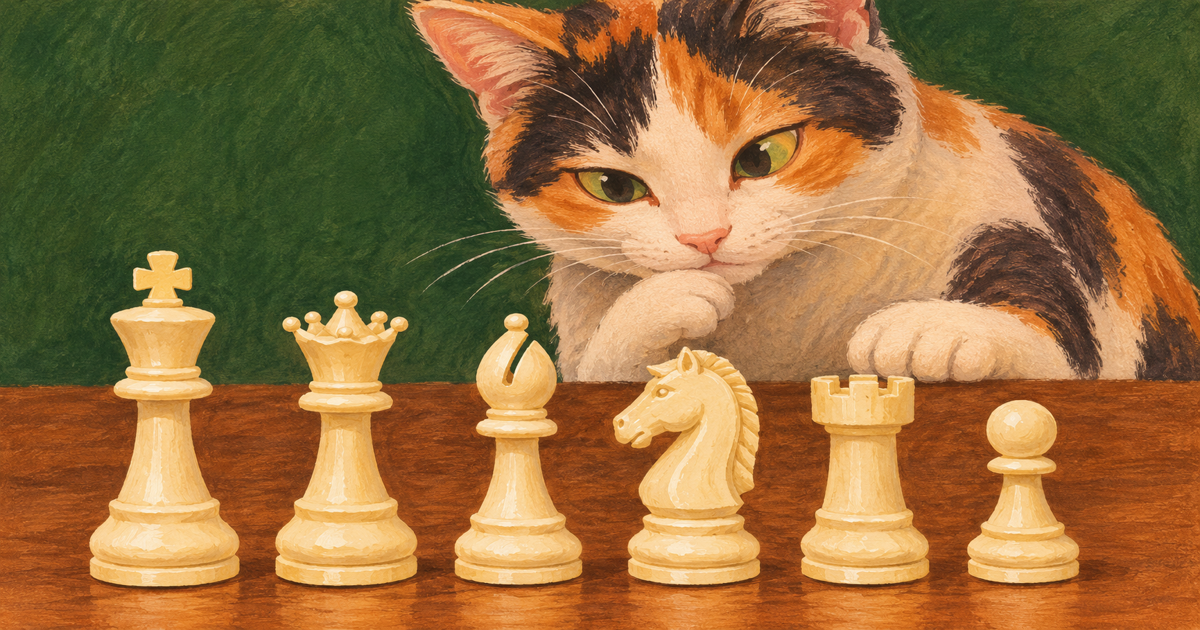
The six chess piece names are king, queen, rook, bishop, knight, and pawn. Each player starts with sixteen pieces: one king, one queen, two rooks, two bishops, two knights, and eight pawns. Learn each name together with its movement so you can identify both a piece and the squares it attacks.
Key takeaways
- There are six piece types and sixteen starting pieces per player.
- English notation uses N for knight and K for king.
- Pawns capture diagonally; knights can jump over pieces.
Names, shapes, and ordinary moves
Shapes vary on artistic sets, so identify unfamiliar pieces before playing. This reference follows FIDE's Laws of Chess, Articles 3.2–3.8.
| Name | Common shape | English letter | Ordinary movement |
|---|---|---|---|
| King | Tall crown, often with cross | K | One square in any direction, without moving into attack |
| Queen | Crown or coronet | Q | Any clear distance along a rank, file, or diagonal |
| Rook | Notched tower | R | Any clear distance along a rank or file |
| Bishop | Slender top with slit | B | Any clear distance diagonally |
| Knight | Horse's head | N | Two squares in one direction, then one perpendicular |
| Pawn | Small rounded head | No letter in moves | Forward movement; diagonal captures |
A file is a column labeled a–h. A rank is a row numbered 1–8. A diagonal runs through the corners of consecutive squares. No piece may finish an ordinary move on a friendly piece's square.
King and queen
The king cannot move into check, so opposing kings cannot stand adjacent. Checkmate ends the game; you do not capture the king. A move exposing your own king to attack is illegal, regardless of which piece moves.
The queen combines rook and bishop movement but cannot jump or turn corners. From d4 on an otherwise empty board, it can reach d8, a4, or g7, but not f5. That last square is neither on the same rank or file nor on a diagonal.
The queen-and-king checkmate guide shows their different movements working together.
Rook and bishop
A rook follows ranks and files; a bishop follows diagonals. Both stop at a blocking piece. They may capture an enemy blocker, but cannot continue beyond it during that move.
A bishop stays on its starting square color. Imagine a white bishop on c1 with a white pawn on d2: it cannot pass through that pawn to e3 or f4. Trace the whole route before deciding a bishop protects something. This also helps identify hanging pieces.
Knight and pawn
The knight jumps directly to its L-shaped destination. From g1, its board destinations are e2, f3, and h3. In the starting position, its own pawn occupies e2, leaving Nf3 and Nh3 as legal moves. Nearby pieces do not block those jumps.
Pawns move toward the opponent: White toward higher rank numbers, Black toward lower ones. A pawn normally advances one square into an empty square. From its starting square, it may advance two if both squares ahead are empty.
Captures differ. A white pawn on e4 can advance to empty e5 or capture an enemy on d5 or f5. An enemy on e5 blocks it. Promotion and en passant are additional pawn rules to learn separately.
Remember the starting row
With White nearest you and a light corner square on your right, a1 through h1 contain:
Rook, knight, bishop, queen, king, bishop, knight, rook.
White pawns occupy rank two; Black's corresponding rows are ranks eight and seven. Queens start on their own colors: White on d1, Black on d8.
For practice, name a piece, describe its destinations, then check what blocks it. Connecting names to legal movement makes recognition useful during your next game.