
After your opponent moves, identify what changed. Before you commit to your reply, inspect their available checks, captures, and direct threats in the resulting position. This will not eliminate every blunder, but it gives you a concrete routine to practice instead of telling yourself to concentrate harder.
A blunder label describes a move's consequence under an analysis method. It does not explain the cause. You might have missed a knight attack, calculated the wrong reply, played too quickly, or followed a plan that stopped fitting the position. A useful improvement plan distinguishes those possibilities.
If your main problem is dropping undefended pieces, start with the specific loose-piece check. This article extends that check to forcing threats and unsafe plans.
Key takeaways
- Reassess the opponent's threat after every move.
- Use checks, captures, and threats as a search order, not a rule that every check is good.
- Review the missed reply and the point at which your calculation stopped.
Replace “be careful” with an observable action
“Be careful” gives you no way to tell whether you did the work. “Before moving my queen, look for the opponent's checks” does.
Choose one action for your next practice game. If you routinely overlook the opponent's idea, say it to yourself after each move. If you see the threat but forget it while pursuing an attack, check the opponent's forcing replies again after selecting your move.
You can evaluate that action afterward. At the critical position, did you name the threat correctly? Did your candidate move answer it? A loss can still contain a successful use of the routine, and a win can contain a missed warning.
Begin with the opponent's last move
A move can create an attack, uncover a line, remove a defender, or make space for another piece. Ask what is different before searching for your own combination.
A pawn move deserves particular attention because it can change diagonals as well as attack squares. A capture can open a rook file. A quiet king move can step into or out of a knight fork.
You do not need to guess the opponent's private intention. Identify what the board permits. “Their bishop now attacks my knight” is more useful than “they are trying to trick me.”
Search forcing moves for both players
Checks narrow the opponent's legal choices. Captures change material and open lines. Direct threats can force a defensive response. Looking at these first gives your calculation a starting structure.
That structure is not a ranking of move quality. A check can lose a queen, and a quiet move can be the strongest defense. After finding a candidate, calculate a plausible response before deciding it works.
Use this short decision table:
| What you find | What to do next |
|---|---|
| Your king is in check | Find legal ways to answer the check before considering other plans. |
| Your move allows an immediate mate | Reject it unless your own move ends the game first. |
| A capture seems to win material | Test recaptures and forcing replies. |
| Several moves look safe | Compare development, king safety, and piece activity. |
The table is a thinking aid. It does not replace the rules or a calculation of the actual position.
See a forcing threat through to its result
Use this illustrative position with White to move:
3r3k/8/8/4N3/8/8/8/6K1 w - - 0 1
White has a king on g1 and a knight on e5. Black has a king on h8 and a rook on d8. The move Nf7+ attacks the king on h8 and the rook on d8 at the same time.
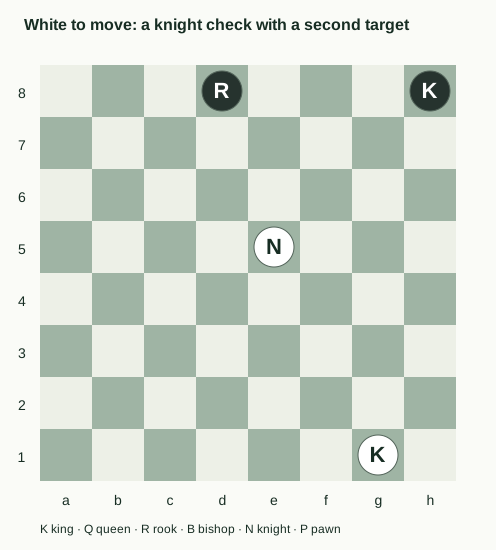
Black must answer the check. In this position Black cannot capture the knight, and a knight's check cannot be blocked. After a legal king move such as ...Kg8, White can play Nxd8 to take the rook.
After the rook is captured, these particular pieces leave king and knight against king, a drawn ending. The diagram isolates a fork; it is not an example of a forced game win.
The fork is more than “a knight attacks two pieces.” One attack is a check, which makes the other threat difficult to answer. That forcing detail explains why the move works.
Now put yourself on Black's side before the fork. The defensive question is whether White has a knight check that also attacks something valuable. Looking only at attacks on the rook misses the tempo gained by checking the king.
Slow down at decisions that change the position
Some moves deserve an extra check: captures, pawn moves near a king, moving the sole defender of a piece, and entering an unfamiliar tactical sequence. These are useful triggers for a pause because they change concrete relationships on the board.
A fixed pause before every move may be impractical in a fast game. Practice the routine in an untimed game or a time control that gives you room to think. The computer-practice guide explains how to choose a level and keep one decision for review. When you do play quickly, use a shorter version: what is threatened, and what is my opponent's strongest immediate reply?
Do not use outside analysis during an ongoing competitive game. The routine is something to learn beforehand and apply yourself at the board.
Review the point where your calculation ended
Afterward, write the sequence you actually considered. Perhaps you calculated “I capture, they recapture, I capture again” but never inspected an intermediate check. Or perhaps you saw the checking move and assumed you could block a knight's attack.
That detail tells you what to practice. It also keeps a single error from becoming an unhelpful judgment about your ability.
Review the finished game, select one missed threat, and explain the reply before saving the position. On your next attempt, search for that reply without the engine answer showing. The goal is a more reliable decision process, with the result checked on the board.
Verify the ending, too
The FIDE Laws of Chess, articles 3.9 and 5.2.2, cover answering check and dead positions. In the fork example, taking the rook leaves too little material for either side to mate. If engine numbers are confusing, read what an evaluation can and cannot tell you.